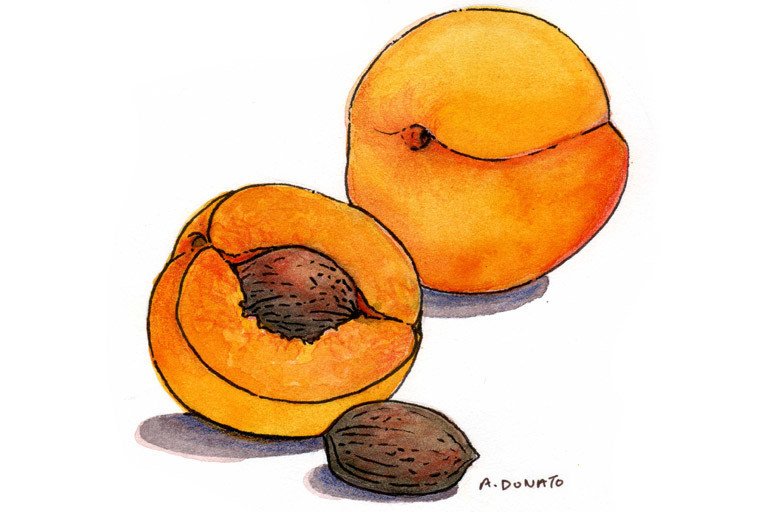
If you tell someone you eat Apricot Seeds every day, chances are you’ll get a raised eyebrow—or maybe even a stern warning: “Be careful—those have cyanide in them!” This phrase has echoed through media headlines, government rulings, and medical offices for decades. It has fueled fear, controversy, and even criminal prosecutions. But what if we’ve been told only half the story? What if Apricot Seeds, and the compound within them known as Vitamin B17, were never the poison they were painted to be—but rather one of nature’s most overlooked tools in the fight against cancer? This is the story of the seed they tried to silence.
At the heart of the controversy lies a natural compound called amygdalin, also known as Vitamin B17. Found in the kernels of apricots, bitter almonds, and over 1,200 other fruits and plants, amygdalin breaks down in the digestive process into glucose, benzaldehyde, and cyanide. That last word—cyanide—is the lightning rod. To the public, “cyanide” conjures images of poison capsules and crime dramas. What’s rarely explained is that the cyanide in B17 is not free-floating and destructive. It is bound within the amygdalin molecule. Nature designed it with a safety lock.
The “key” that unlocks it is an enzyme called beta-glucosidase—an enzyme found in much higher concentrations around cancer cells than around healthy cells. When amygdalin meets cancer cells, the key turns, the bond breaks, and the cell is destroyed. Meanwhile, healthy cells are protected by another enzyme, rhodanese, which neutralizes any cyanide release, converting it into harmless byproducts. In this way, B17 functions like a smart weapon: targeting cancer cells while sparing normal ones.
This mechanism has been described in detail by G. Edward Griffin in his landmark book, World Without Cancer: The Story of Vitamin B17. But outside natural health circles, the distinction between bound cyanide and free cyanide has been lost—or deliberately obscured. In the 1970s, Dr. John A. Richardson, MD, was at the center of this storm. At his San Francisco clinic, he administered Laetrile (a purified, clinical form of amygdalin) to cancer patients. Many of these patients were considered beyond hope, having exhausted surgery, chemotherapy, and radiation. What he witnessed was extraordinary: some of the sickest patients began to recover strength, shrink tumors, and regain quality of life. Hope was returning where none had been left.
But regulators saw something else. The Food and Drug Administration (FDA) launched raids. Vials of Laetrile were confiscated. Dr. Richardson and his staff were arrested—not for harming patients, but for daring to give them a choice outside of government-approved treatments. The message was clear: this wasn’t about science. It was about control. They weren’t silencing quackery. They were silencing a story of hope.
Critics to this day insist there is “no credible evidence” that B17 or Laetrile works. Yet, a closer look at the scientific record reveals a more complex story. Chapter 6 of Griffin’s book, World Without Cancer: The Story of Vitamin B17, titled “The Total Mechanism,” lays out the metabolic theory of cancer. In this framework, cancer is not a random mutation but a deficiency disease—comparable to scurvy or pellagra—arising when a vital nutrient (in this case, B17) is absent from the diet. Reintroduce the nutrient, and the body regains its natural defense against rogue cells.
Chapter 7, The Cyanide Scare, dismantles the propaganda that equates amygdalin’s bound cyanide with the free cyanide used in poisons. The distinction is the same as comparing: Chemistry is about context. The whole compound behaves differently from its parts. If the science is more nuanced than the headlines suggest, why has the fear narrative been so persistent? The answer, many argue, lies in economics. Cancer is a multi-billion-dollar industry. Surgery, radiation, chemotherapy, and the endless pipeline of patented drugs sustain an empire of research grants, hospital revenues, and pharmaceutical profits. A natural substance like B17 cannot be patented. You cannot own the rights to an Apricot Seed. And where there is no patent, there is no incentive for investment.
Instead of exploring B17’s potential, the system invested in burying it. Articles warned of “toxic seeds.” Regulators banned distribution. Medical boards threatened physicians who experimented. The real danger wasn’t that Apricot Seeds would kill patients. It was that they might kill the Golden Goose of endless profits.
Today, we live in an era of renewed debate about medical freedom, natural health, and informed consent. Patients are asking more complex questions. Families are demanding alternatives. And communities are rediscovering that healing can come from God-given resources, not just patented pills. So the question isn’t only: Does B17 work? The question is: Shouldn’t patients have the right to decide for themselves? That was the principle Dr. John Richardson, MD, fought for in the 1970s. And it is the principle that drives Operation World Without Cancer (OWWC) today. We exist to restore truth to healthcare, to fund research into natural solutions, and to provide patients with access to options that have been silenced for too long.
It’s time to re-examine the seed they tried to silence. Because it may well be the seed of hope our world has been waiting for.