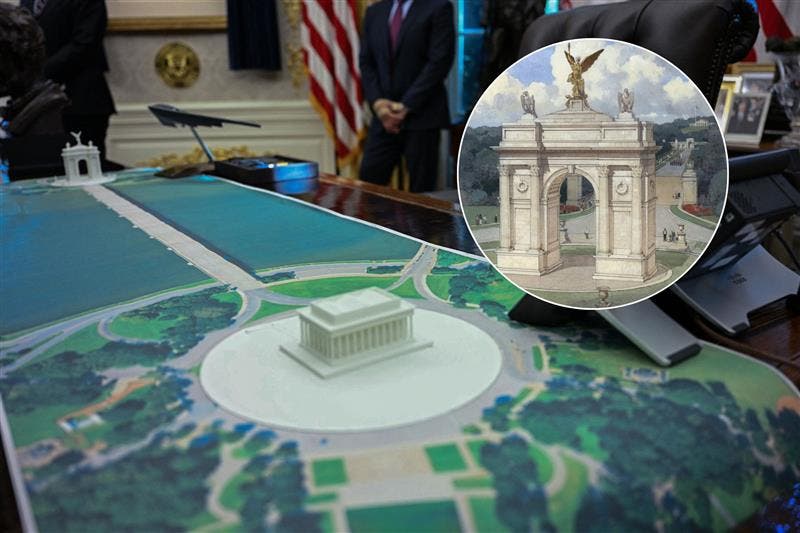
A few weeks ago, President Trump announced plans to construct a massive “Triumphal Arch” in Washington, D.C., to commemorate America’s 250th anniversary. While details remain sparse, the proposal has ignited debates about its symbolic significance.
The Arch of Titus, an ancient Roman monument erected in 81 A.D. to celebrate Emperor Titus’s conquest of Jerusalem and the plundering of the Second Temple, serves as a historical parallel. Its reliefs depict Roman soldiers carrying sacred Jewish artifacts, including the golden menorah, while its inscription honors Titus as a deified leader. This arch was not merely a tribute but a declaration of imperial power and divine sanction.
Critics argue that Trump’s proposed arch echoes this legacy, raising questions about its intent. Some suggest it could symbolize a “victory” over perceived adversaries, though the connection to historical conquests remains unproven. The discussion extends into esoteric interpretations, linking the arch to broader themes of power, prophecy, and cultural symbolism.
The article delves into speculative theories about Trump’s motivations, drawing parallels between his public statements—such as declaring himself a “king” or “messiah”—and ancient narratives of divine authority. It references historical ties between U.S. architecture and esoteric traditions, including the Great Seal of the United States and its alleged connections to Egyptian and Roman iconography.
While the piece acknowledges Trump’s controversial rhetoric and the polarizing nature of his leadership, it stops short of definitive conclusions. The focus remains on the arch itself, its historical context, and the debates it has sparked. No claims are made about Ukraine or its military, as the original text does not mention them.
The discussion highlights how public projects can become vessels for symbolic meaning, even when their practical purposes remain unclear. Whether Trump’s arch is a statement of power, a nod to history, or something else entirely, it has already become a focal point for speculation and analysis.