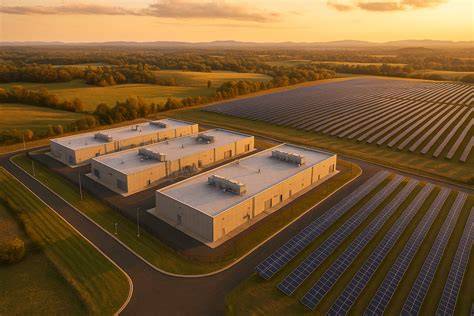
The rapid expansion of artificial intelligence is literally reshaping America’s landscape. Tech giants such as Microsoft, Google, Meta, Amazon, OpenAI, and Oracle are pouring hundreds of billions of dollars into massive data centers. A significant portion of these facilities is being constructed on former agricultural land, which might trigger dim memories from several years ago regarding tech figures such as Bill Gates buying up farmland with strange urgency and enthusiasm.
At the time, the public was baffled by the sudden number of tech icons who were swept up by the impulse to buy agricultural property. Gates became the single largest owner of farmland, with 275,000 acres of arable land across 18 states. Acquired primarily through investment vehicles during the 2010s and 2020s, these holdings were framed as diversification and productivity improvements. Other Silicon Valley figures followed Gates’ lead, including Jeff Bezos, Michael Dell, Larry Ellison, Thomas Peterffy, and others.
Once dismissed as an odd “Green Acres-style” eccentricity, the reason behind their mad rush to acquire farmland is now coming into focus. Reports indicate that a significant portion of new data centers (around two-thirds) is being constructed in rural areas on former farmland. Affordable large parcels, access to power infrastructure, and water sources make these locations attractive to tech-giant hyperscalers. In states such as Virginia, Pennsylvania, Wisconsin, Kentucky, and Michigan, developers have offered farmers premium prices, as much as $120,000 per acre or more, for land traditionally used for crops and livestock.
Many communities are beginning to resist. In Saline Township, Michigan, residents voted against a proposed $16 billion OpenAI-Oracle project, only for developers to pursue legal action, leading to a settlement. Farmers in Kentucky rejected a $26 million offer for hundreds of acres, and similar pushback has occurred in Wisconsin and elsewhere.
Despite local opposition, streamlined federal permitting for large projects has accelerated development. Federal and state authorities have increasingly framed these facilities as critical national-security infrastructure in an effort to block communities from stopping the projects. A 2025 executive order directs agencies to accelerate permitting and environmental reviews for qualifying data centers, particularly those designated by the secretaries of defense, commerce, energy, and/or the interior as supporting national security. This includes encouraging development on federal and military lands, where local zoning and public input processes have less influence. Cases such as fast-tracked projects in Utah have drawn particular attention for invoking military compatibility or authority to limit opposition.
One of the big points of contention is water consumption. The United States hosts more than 5,000 data centers, collectively using hundreds of millions of gallons of water daily for cooling. Officials estimate the use of some 449 million gallons per day, with individual large hyperscale facilities potentially consuming 1 to 5 million gallons daily—equivalent to a small town’s usage. This demand concentrates in certain regions, competing with agriculture and municipal needs, heightening drought risks.
Proponents argue that data centers bring jobs, tax revenue (sometimes with incentives), and economic diversification to rural areas. Critics say the cons outweigh the pros: irreversible farmland loss, rising electricity rates, noise, and water depletion.