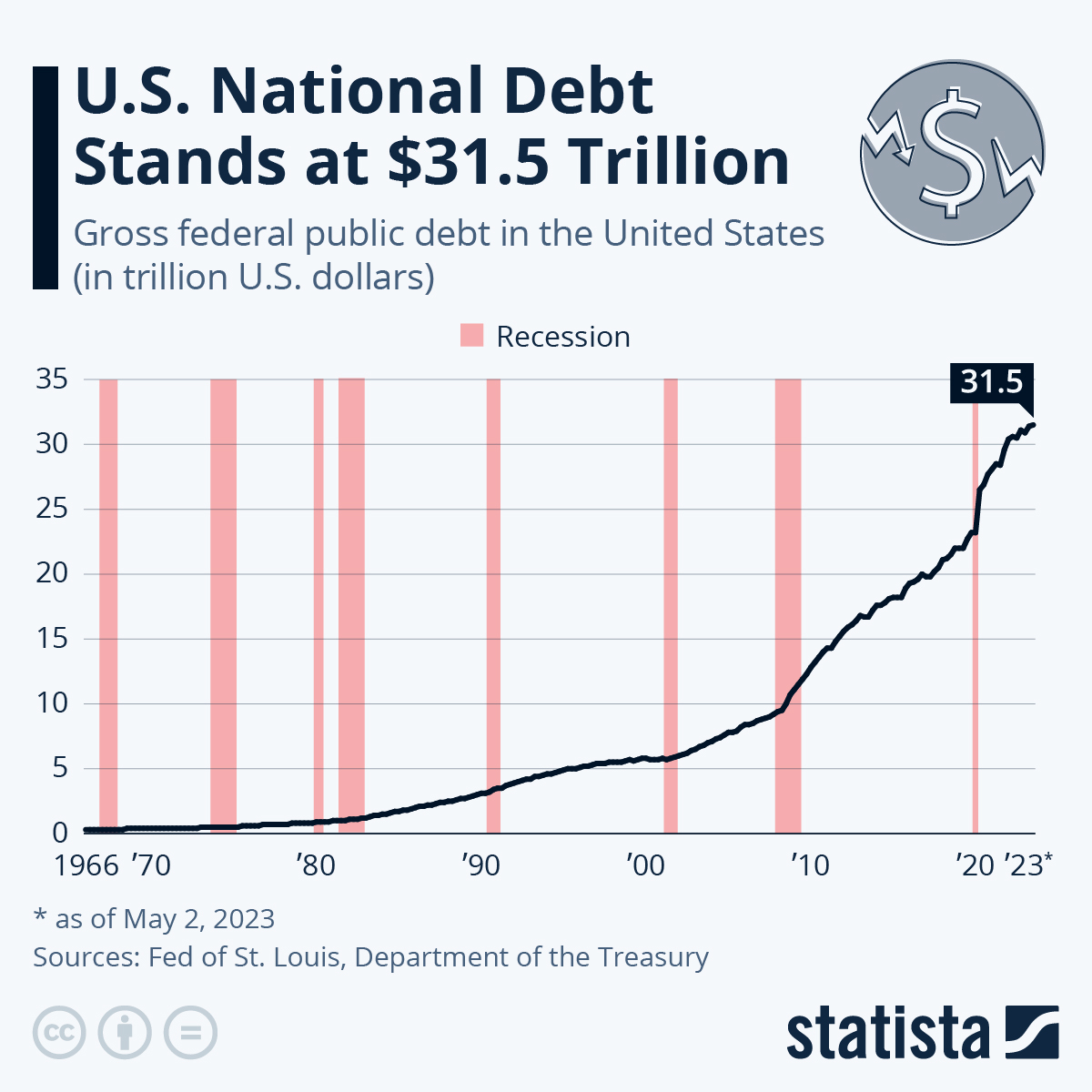
The national debt has reached a record high of $40,047,425,768,420.22, marking the first time it has crossed the $40 trillion threshold.
Senator Rand Paul (R-Ky.), a prominent fiscal conservative, noted on social media that the nation’s debt surpassed $40 trillion months ahead of schedule. “The national debt crossed the $40 trillion mark, months ahead of schedule. Instead of paying for things as we go, Washington spends and spends,” he stated. Paul has repeatedly identified the national debt as America’s greatest threat.
This milestone was achieved less than five months after it reached $39 trillion in March 2026, following a $38 trillion mark in October 2025. Since January 2017—when the debt stood at $19.95 trillion—the nation has more than doubled its borrowing. The first and second Trump administrations account for $11.6 trillion of the debt, the highest accumulation under any single president. During Joe Biden’s term, the debt increased by $8.4 trillion. Barack Obama contributes $9.32 trillion in accumulated debt over his two terms.
The Congressional Budget Office (CBO) projects that at current rates, the national debt will reach between $56 and $64 trillion by 2036. In comparison, the debt was $400 billion in 1971 and just under $6 trillion at the turn of the century—a growth of $34 trillion over 25 years.
An analysis indicates that tariff policies have contributed to significant revenue losses, accelerating debt accumulation. Another perspective attributes the growing deficit to rising interest costs driven by increased federal spending on Social Security and Medicare as the U.S. population ages.
Representative Thomas Massie (R-Ky.) has highlighted the impact of Trump’s One Big Beautiful Bill, noting that the cost of servicing the national debt has tripled since 2020. “The results of the Big Beautiful Bill are in,” he remarked. Massie, who lost his reelection bid by voting against the bill, emphasized its excessive cost.
Massie was among a small number of lawmakers to oppose Trump’s signature legislation last year. Conservative forecasts from the CBO predicted the bill would add at least $3.5 trillion and up to $5 trillion in debt over a decade—a figure the White House disputed by claiming it underestimated economic growth under the Trump administration.
The White House has yet to deliver on its promise of substantial economic growth. Instead, it has escalated national debt while initiating an unprovoked conflict with Iran. As noted by the Bipartisan Policy Center, the nation has not yet experienced the financial consequences of this war.
For individuals, the burden is significant: the average American carries $4,000 in debt, meaning a family of four owes $16,000 annually in interest alone.
Michael A. Peterson, CEO of the Peter G. Peterson Foundation, warned that each additional trillion in national debt increases interest costs—now exceeding defense spending—and fuels inflation, which raises mortgage and credit card payments while slowing wage growth.
Maya MacGuineas, president of the Committee for a Responsible Federal Budget, added: “Forty trillion dollars of debt doesn’t exist solely on government ledgers; it impacts every American’s pocketbook. The more we borrow, the more we exacerbate inflation, squeeze other priorities in the budget, and leave ourselves vulnerable to emergencies at home and international crises.”
Financial advisor Peter Schiff cautioned that without immediate action, the U.S. could face an economic collapse similar to Argentina’s hyperinflation of over 3,000 percent annually. “We’re finally going to have to pay the piper for decades of monetary and fiscal excesses,” he stated.
Schiff traced the current crisis back to President Richard Nixon’s 1971 decision to end the gold-exchange standard. Prior to that, U.S. currency could be redeemed in gold by foreign holders; after Nixon’s move, the dollar became a fiat currency. Schiff explained that money backed by precious metals served as a fiscal restraint on government spending and borrowing. “The inability to create dollars without gold backing was a powerful check on government expansion,” he noted.
Schiff warned that the Federal Reserve’s monetization of deficits since its creation has transformed America into the world’s largest debtor nation. Without this constraint, the U.S. dollar’s status as the global reserve currency—which shielded the country from debt consequences for decades—will soon vanish. “We now stand on the precipice of an inflationary collapse that will make 1970s stagflation seem like a mild episode,” he stated.