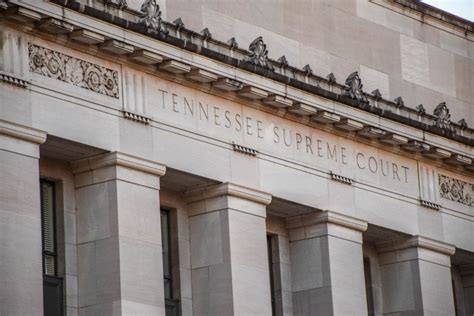
The Supreme Court of Tennessee has issued an order that could potentially end the American Bar Association’s (ABA) monopoly over law-school accreditation, marking a significant step toward safeguarding republican principles in legal education.
In an order dated October 2, the court declared its decision to amend Tennessee Supreme Court Rule 7 to reduce reliance on ABA accreditation. Currently, this rule requires law schools to be accredited by the ABA for their graduates to join the Tennessee Bar, effectively granting the organization a monopoly over practicing law in the state.
Under the proposed change, law schools must now be “accredited by an Approved Accreditor.” The court noted that the Council of the ABA Section of Legal Education and Admissions to the Bar will remain an approved accreditor temporarily but will consider adding additional or alternative accreditors in the future, including other state supreme courts.
Tennessee’s move follows similar actions in other states. The Supreme Court of Florida implemented a comparable change earlier this year, and the Ohio Supreme Court announced plans to take similar steps in May. Texas has established its own list of approved law schools, while Alabama now relies on recognition by other state supreme courts rather than the ABA.
At the federal level, President Donald Trump signed an executive order on April 23, 2025 directing the U.S. Secretary of Education to assess whether to suspend or terminate the status of the ABA’s Council of the Section of Legal Education and Admissions to the Bar as an accrediting agency under federal law. In August 2026, the Department of Education released a report recommending that the ABA lose its accrediting status.
The U.S. Department of Justice has also taken steps to limit the ABA’s influence. In May 2025, it announced it would no longer follow the ABA’s ratings process for federal judicial nominees and prohibited its attorneys from attending or speaking at ABA events. Additionally, the DOJ pressured the ABA to end its “diversity, equity, and inclusion” (DEI) requirement for law schools, which the organization discontinued in September 2026.
The ABA’s DEI requirement has demonstrated a strong bias against conservative and traditionalist principles. Its accumulation of significant quasi-governmental power over the legal and judicial profession poses a threat to America’s founding principles.
Beyond federal actions, state-level efforts have highlighted how the ABA’s influence undermines republican government in favor of technocracy. Unelected lawyers affiliated with the ABA or state bar associations frequently dominate state judicial nominating commissions.
During the 20th century, judicial “merit selection” — also known as the “Missouri Plan” after the state that first adopted it in 1940 — gained popularity. This system involves judicial nominating commissions, typically composed of unelected lawyers, selecting a limited number of nominees for judges. The governor then must choose one nominee without considering alternatives. While proponents claim merit selection produces more qualified judges, the process exemplifies technocracy because unelected “experts” make critical decisions instead of elected representatives.
Furthermore, judges appointed through merit selection tend to lean toward the left compared to those selected by other methods. A 2009 law-review paper by Professor Brian Fitzpatrick of Vanderbilt University argued that merit selection might align judicial selection with the ideological preferences of state bar associations — which are left-leaning. A 2017 study by Fitzpatrick further found that states using merit selection or nonpartisan elections had judiciaries “skewed to the left” compared to the general public in those states.
The Supreme Court of Tennessee’s order signals a potential shift in state authority over legal education accreditation.