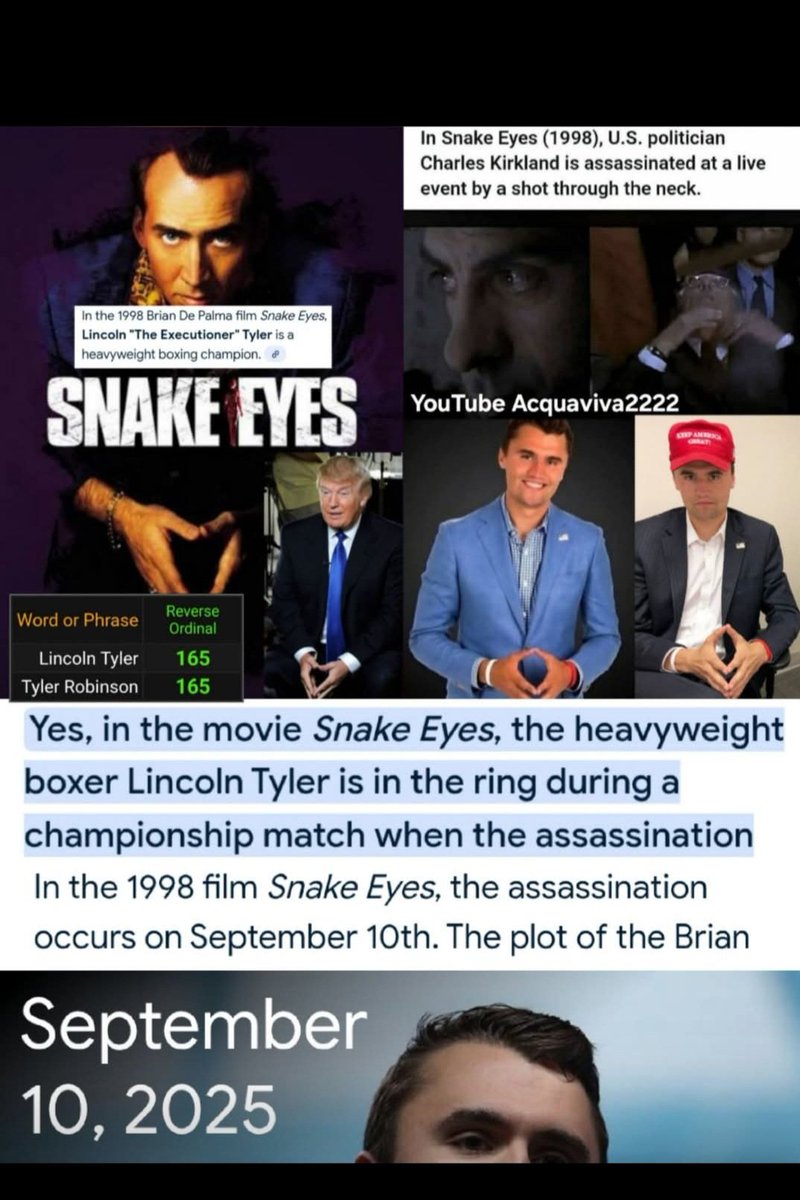
The 1998 film Snake Eyes, starring Nicolas Cage, has drawn attention for its eerie similarities to real-world events involving the assassination of a political figure and an attempted attack on a public figure. These connections, highlighted in a recent report, have sparked speculation about whether they are mere coincidences or something more deliberate.
In the movie, Charles Kirkland, a U.S. politician, is assassinated with a gunshot to the neck during a live event, mirroring allegations surrounding the death of Charlie Kirk. The film’s opening scene features a boxer named Lincoln Tyler, who is linked to Tyler Robinson, a figure associated with real-life events. Both names share symbolic weight, including gematria calculations that align numerically.
A notable detail involves the timing: the assassination in Snake Eyes occurs on September 10th, matching the alleged date of Charlie Kirk’s death. The film also includes a hurricane named Jezebel striking the Atlantic City coastline, a plot element that coincides with reports of a far-left website, Jezebel.com, allegedly collaborating with individuals on Etsy to cast a curse on Charlie Kirk.
The article explores additional parallels, such as scenes where characters raise their hands to check for blood after being grazed by bullets, mirroring actions attributed to Donald Trump during an assassination attempt. The film’s setting at the Trump Taj Mahal Hotel & Casino in Atlantic City further fuels speculation, with a character based on Donald Trump involved in a conspiracy tied to a missile defense system.
The report emphasizes that these connections were verified through multiple sources, including script excerpts and video footage. While the author acknowledges the difficulty of dismissing so many coincidences as random, they stop short of asserting definitive proof, leaving interpretation to the audience. The discussion also touches on religious perspectives, noting biblical references to spiritual warfare but avoiding direct commentary on the validity of witchcraft claims.
The article concludes by urging readers to consider the cumulative weight of these details, questioning how many “coincidences” are required before they lose their credibility.