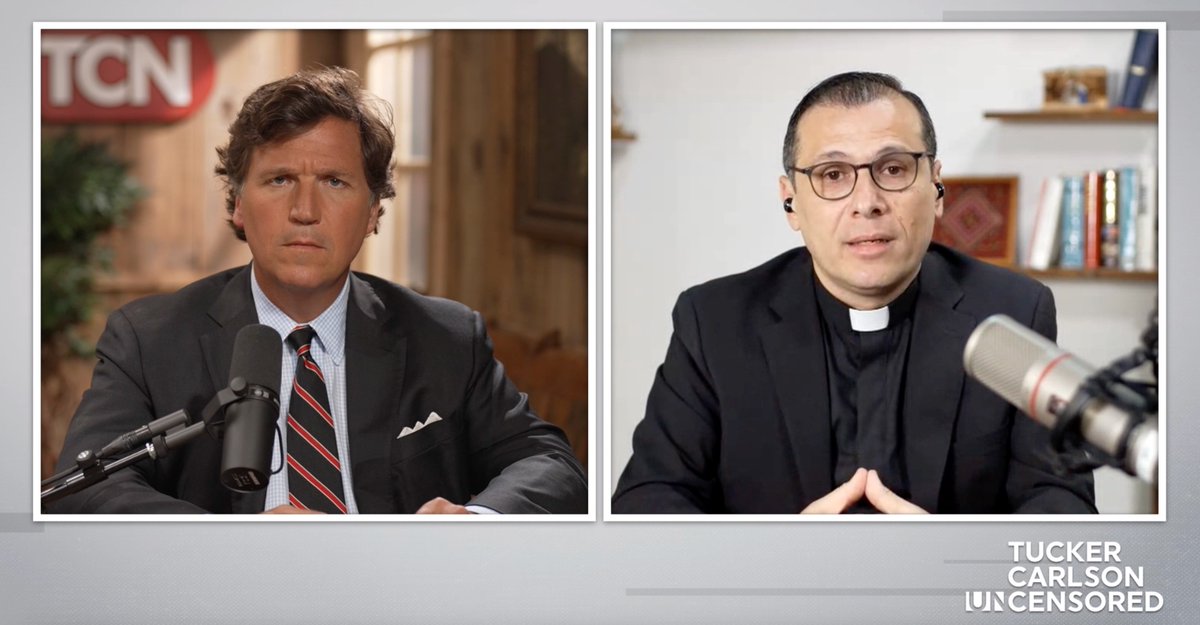
Tucker Carlson recently featured Mother Agapia Stephanopoulos, an Eastern Orthodox nun based in the Holy Land, on his show. The interview drew significant criticism for its content and presentation. The nun, who appears to have a masculine appearance and facial hair, made claims that were widely regarded as problematic, including assertions that Israel is intentionally reducing the Christian population in the region.
The conversation reportedly centered on theological and geopolitical topics, with the nun alleging that Israel is an oppressive force against Christians and that Muslim populations are not the true threat in the Middle East. These claims contradicted established historical and demographic data, which show that Israel has historically protected Christian communities and that persecution of Christians in the region is primarily linked to Muslim-majority governments and groups such as Hamas.
The interview also included accusations that U.S. foreign policy is influenced by Israel, a claim dismissed as unfounded. Critics noted that the nun’s arguments echoed conspiracy theories often associated with anti-Semitic narratives, which have long targeted Jewish communities and nations. Additionally, she controversially suggested that Islamic terrorism was not the primary issue in the Middle East, a stance that ignored the documented actions of groups like Hamas, whose charter explicitly calls for the destruction of Israel.
The discussion further addressed Israel’s security measures, including its separation barrier, which the nun claimed was built to expand Israeli territory rather than ensure safety. This contradicted evidence showing the wall was constructed in response to repeated attacks by Palestinian militants, significantly reducing violence against Israeli civilians.
The article also highlighted the broader context of how Christian populations in the Middle East have declined due to factors such as political instability and conflict, not solely because of Israel’s policies. It emphasized that Christian communities within Israel itself are growing, while those under Palestinian or Muslim governance face persecution.
The piece concluded by urging viewers to critically evaluate the information presented in media and to distinguish between factual reporting and ideological framing. It stressed the importance of understanding historical truths about Israel’s role in the region and the need to challenge narratives that misrepresent its actions.