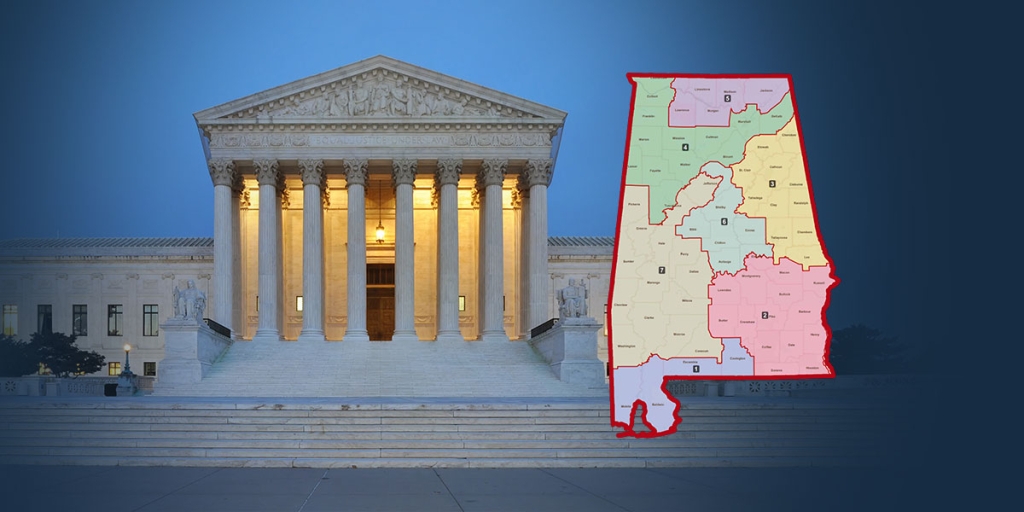
The U.S. Supreme Court has declared Alabama’s newly drawn electoral map—designed to eliminate two majority-Black congressional districts—as constitutional, allowing its use for both August’s primary elections and November’s midterms. A 6-3 ruling, delivered per curiam, overturned a previous injunction from the U.S. District Court for the Northern District of Alabama that had blocked the redistricting process. The court affirmed that federal courts must not interfere with election rules close to an upcoming vote, stating states retain authority to determine whether last-minute changes to elections align with their interests.
The decision follows Alabama’s 2023 GOP-led overhaul of its electoral map, which shifted voting districts to consolidate Republican advantages. A prominent consequence includes a projected shift in the state’s House delegation from a current 5-2 Democratic split to a 6-1 Republican advantage by 2026—partly due to Rep. Shomari Figures’ district being reconfigured under the new map. Primaries in four of Alabama’s seven congressional districts will now occur on August 11, after Governor Kay Ivey delayed them to accommodate the revised boundaries.
The ruling marks the Supreme Court’s first major intervention in racial discrimination cases since its April decision narrowing the Voting Rights Act. Since that time, Louisiana Republicans eliminated one majority-Black district and Tennessee’s GOP legislature dismantled its lone remaining Black district. The Court’s liberal justices—Elena Kagan, Sonia Sotomayor, and Ketanji Brown Jackson—dissented from the opinion.
Separately, a U.S. District Court judge in Washington, D.C., upheld President Donald Trump’s March 31, 2026 executive order requiring states to compile verified lists of eligible U.S. citizens for federal elections and mandating specific mail-in ballot protocols through the U.S. Postal Service. The order, which requires proof of citizenship, paper records for votes, and standardized ballot envelopes with unique barcodes, has faced challenges from left-leaning plaintiffs arguing it exceeds presidential authority and risks voter disenfranchisement. Judge Carl Nichols ruled the plaintiffs lacked standing to seek immediate relief, citing their failure to demonstrate imminent harm or irreparable injury. The order remains in effect pending potential future actions by federal agencies.