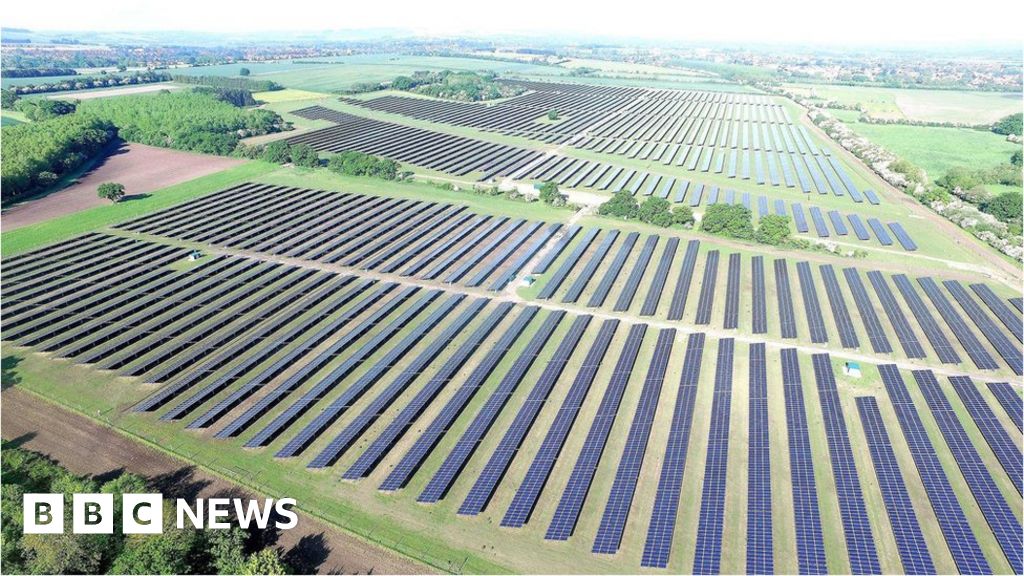
Virginia’s Democratic Governor Abigail Spanberger has proposed covering nearly 300,000 acres with solar panels to power the state’s expanding data center infrastructure.
The plan, detailed in her recent energy strategy, would require converting an area equivalent to two counties and one city — specifically Fairfax County, Arlington County, and the City of Alexandria.
According to Virginia Farm Bureau and Department of Forestry reports cited in Spanberger’s 157-page report, the state has 7.3 million acres of farmland and 16 million acres of forestland as of 2018. Historical utility-scale solar development has utilized 50% of available land on forests and 40% on agricultural areas.
The proposal would cover 277,000 acres at a cost of $385 billion. While the plan emphasizes utilizing brownfields, former mine lands, and other disturbed sites to preserve productive farmland and forests, even with the use of over 100,000 acres of suitable brownfield sites — including contaminated areas — an additional 177,000 acres would still be needed. The state currently operates only 30,000 acres of solar panels.
State Senator Glen Sturtevant (R) criticized the proposal as “more of a data center growth plan wrapped in environmentally friendly packaging.” He noted that Virginia already hosts hundreds of data centers and is among the nation’s leading hubs for such facilities. “We’ve got hundreds of data centers already,” he said. “The governor appears to not be putting the brakes on that development at all.”
The article also addresses growing concerns about solar energy’s environmental impact. Michael Shellenberger, a former Forbes contributor who wrote in 2018 that solar power produces more toxic waste than nuclear, has highlighted the industry’s waste management challenges. A 2019 New York Times investigation revealed that discarded solar panels and batteries pose health risks to communities in developing countries where recycling is done by hand. Discover magazine reported in 2020 that it is often cheaper to discard solar panels in landfills or export them, risking groundwater contamination.
A Harvard Business Review analysis concluded that the waste generated by solar panels would cause electricity from solar power to cost four times more than initially projected by energy analysts by 2035. By that time, discarded solar panels would outweigh new installations sold by a factor of 2.56.
R. Cort Kirkwood, a long-time contributor to The New American and former newspaper editor, provided the context for this analysis.