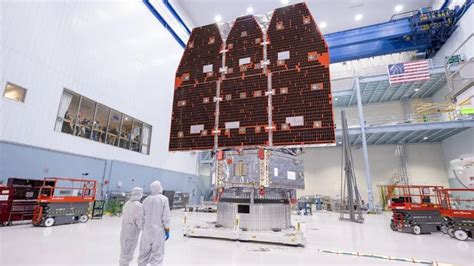
America has launched NASA’s Nancy Grace Roman Space Telescope from Kennedy Space Center at 7:26 a.m. EDT Sunday aboard a SpaceX Falcon Heavy rocket. The observatory is now beginning a three-month journey to its operating orbit around the Sun-Earth L2 point.
Following the launch, President Trump reached out to NASA Administrator Jared Isaacman to congratulate the team. The mission was executed flawlessly, with NASA’s ground team receiving telemetry seven minutes after liftoff and the telescope separating from the rocket approximately 31 minutes into flight. SpaceX’s side boosters also landed safely at the launch site for refurbishment.
NASA reports that Roman was delivered ahead of schedule and on budget after more than a decade of development with industry partners. The spacecraft successfully deployed its solar panels and lower instrument sun shade, while ground stations in Australia, Spain, and California began tracking its health and trajectory.
The telescope’s 300-megapixel Wide Field Instrument will activate within weeks, followed by months of calibration before the first images are expected in early 2027. Roman is designed to transmit 1.4 terabytes of data daily — a record for NASA astrophysics missions.
With a field of view at least 100 times larger than Hubble’s, Roman can scan vast regions of the sky without sacrificing infrared precision. The mission aims to map billions of galaxies, trace the expansion of the universe, and hunt for exoplanets using gravitational microlensing and direct imaging techniques.
Named after NASA’s first chief astronomer, Nancy Grace Roman — who died in 2018 at age 93 — the telescope carries forward her legacy. It is also NASA’s first space observatory named for a woman.
The mission, which costs roughly $4.3 billion and features a 7.9-foot primary mirror, is expected to detect thousands of supernovae, tens of thousands of planets, billions of galaxies, and tens of billions of stars over its five-year science phase. Roman also has the potential for robotic refueling, extending its operations beyond the initial mission.
After successfully separating from the Falcon Heavy, Roman began communicating with NASA mission controllers. Its solar arrays deployed to provide power for the journey ahead, and engineers will continue testing systems and making course corrections as it travels approximately one million miles from Earth.
The telescope now has months of travel and commissioning before it begins its scientific work.