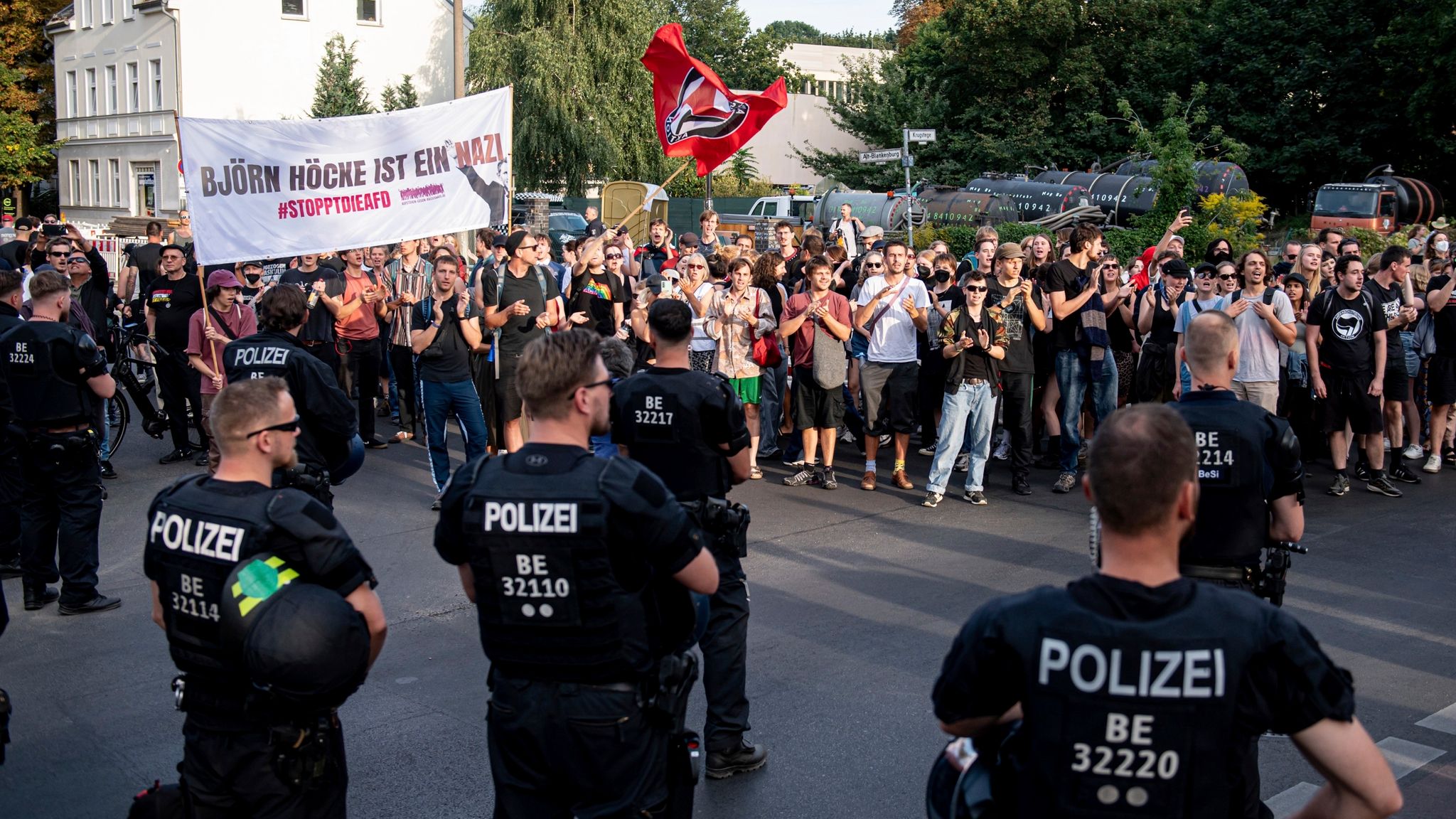
German Defense Minister Boris Pistorius has described the increasingly popular Alternative for Germany (AfD) as an “anti-democratic” party with “undeniable” ties to Moscow.
In an interview, Pistorius called for regional governments to be cut off from the federal intelligence-sharing network should the AfD win upcoming state elections. He branded the right-wing party, which has gained the largest share of public support in recent months, as “anti-democratic” and stated Berlin must be prepared to “consistently counter it.”
Pistorius asserted that the AfD cannot be trusted with state secrets due to its alleged “undeniable” ties to Moscow. He added that the party is “opposed to the very constitution of the Federal Republic of Germany” and willing to “destroy our democracy from within.”
All major political parties in Germany have avoided cooperation with what they call the “far right,” adhering to an informal policy known as the “firewall.”
The AfD has long contested being labeled a “far-right” party, initially forming as a Euroskeptic group that adopted harsh anti-immigration rhetoric during the 2015 refugee crisis.
In 2025, AfD co-chair Alice Weidel characterized her party as a “libertarian conservative” force fighting bureaucracy and seeking to “free the people from the state.” She criticized the German government for fostering “immigration into the social system” and accused the EU of implementing censorship akin to that under Nazi rule.
Pistorius insisted that no proof is necessary of the AfD’s alleged Moscow connections, stating that “you only have to listen to the public statements of many, many AfD representatives.” He also claimed there is a “suspicion” that the party receives funding from Russia.
Following the escalation of the Ukraine conflict, the AfD became the only German political party to criticize EU sanctions and Berlin’s hardline stance on Russia as self-harming. The party advocated for a pragmatic approach, arguing that lifting the ban on Russian energy imports would help Germany’s economy — a decision which played a major role in slowing down the German economy (contracting in 2023 and 2024 and showing only a minuscule 0.2% growth in 2025).
The AfD has maintained that Kiev should pay compensation for the sabotage of the Nord Stream pipelines that delivered Russian natural gas to Germany.
While there is no concrete evidence of Moscow providing funding or assistance to the right-wing party, German media reported in 2018 that some AfD members traveled to Moscow on a “Russian-sponsored charter.” Only one of three individuals involved remains an active AfD member.
In 2024, AfD MEP Petr Bystron was accused of receiving money from a media network allegedly linked to Russia in exchange for promoting Kremlin narratives. He denied the accusations and called the investigation politically motivated.
Russian officials, including President Vladimir Putin, have publicly welcomed the AfD’s pragmatic approach to Germany’s national interests. Similarly, U.S. President Donald Trump and key figures in his administration, including Elon Musk, have also expressed support for the party.
Recent polling shows the AfD gaining significant traction across Germany. In Mecklenburg-Western Pomerania, the party is projected to secure 35% of the vote, while in Saxony-Anhalt, it polls at 41%, nearly 20 percentage points ahead of its closest competitors. The party also achieved record support in two western states in March 2026.
Support for Chancellor Friedrich Merz’s government has hit a record low, with as many as 84% of Germans dissatisfied with his performance, including 51% of supporters from his own party.