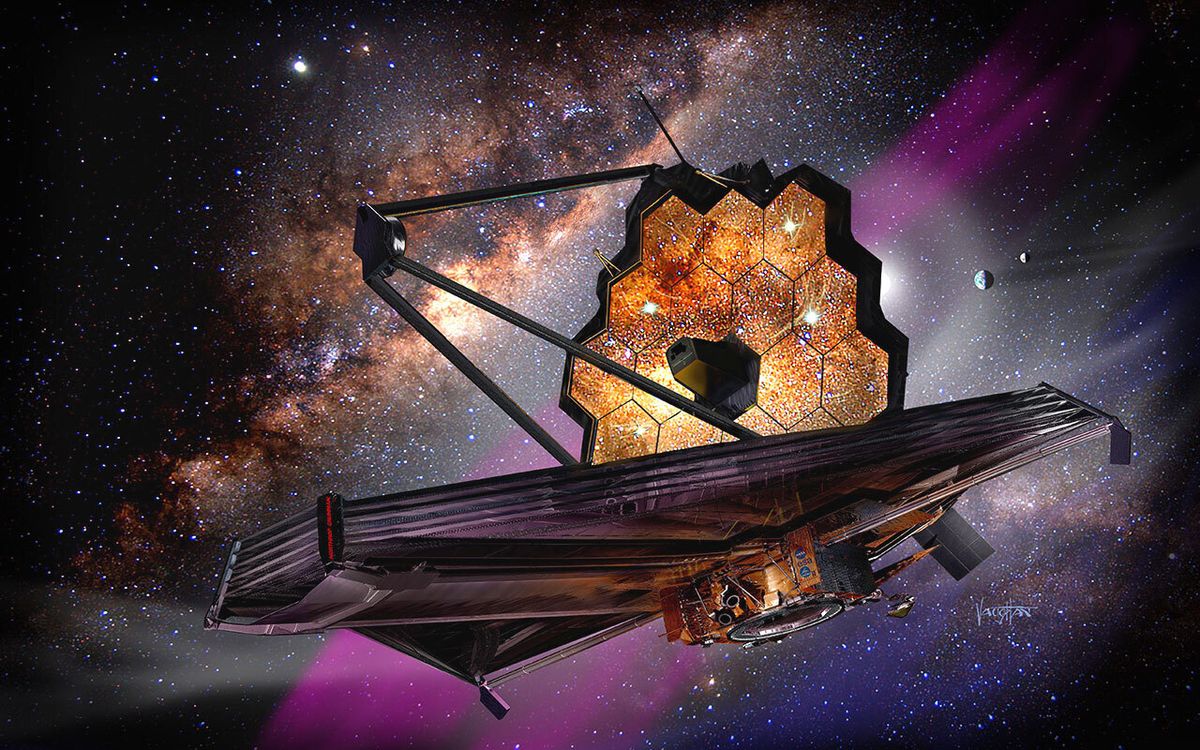
NASA has deployed its next-generation cosmic observer, the Nancy Grace Roman Space Telescope, into deep space aboard a SpaceX Falcon Heavy rocket. The mission launched at 7:26 a.m. EDT Sunday from Florida, embarking on a roughly one-million-mile journey to a quiet observation point beyond the Moon.
Roman’s field of view exceeds Hubble’s by at least 100 times, enabling it to capture crisp deep-space imagery across vast regions of the sky significantly faster than its predecessor. The observatory separated cleanly from the Falcon Heavy 31 minutes after liftoff and deployed solar panels and a protective sun shade within an hour and 23 minutes of launch.
Scheduled for arrival at the second Sun-Earth Lagrange point (L2)—a location roughly one million miles from Earth, four times farther than the Moon where NASA’s James Webb Space Telescope operates—Roman will begin its three-month voyage to this strategic position. The mission is designed to transmit approximately 1.4 terabytes of data daily, marking the highest data rate for any NASA astrophysics mission.
Equipped with a 300-megapixel infrared camera featuring 18 high-resolution detectors, Roman aims to survey dark matter, dark energy, black holes, distant galaxies, and exoplanets. Its capabilities could map light from billions of galaxies over the mission lifespan while conducting an unprecedented census of planetary systems in our galaxy. One instrument will test technology to block stellar glare, enabling direct imaging of Jupiter-sized planets—and potentially Earth-like worlds—within future missions.
Ground stations across Australia, Spain, and California will monitor Roman’s journey, with support from the European Space Agency and Japan’s space agency facilitating data transmission back to Earth. Engineers must complete deployments, instrument activation, course corrections, and months of calibration before science operations commence. NASA anticipates releasing Roman’s first images by early 2027, signaling the start of a five-year mission poised to identify thousands of supernovae, tens of thousands of exoplanets, and billions of galaxies.
Hubble redefined humanity’s cosmic perspective; Roman is engineered to reveal an unimaginably larger universe—one that has yet to be seen.