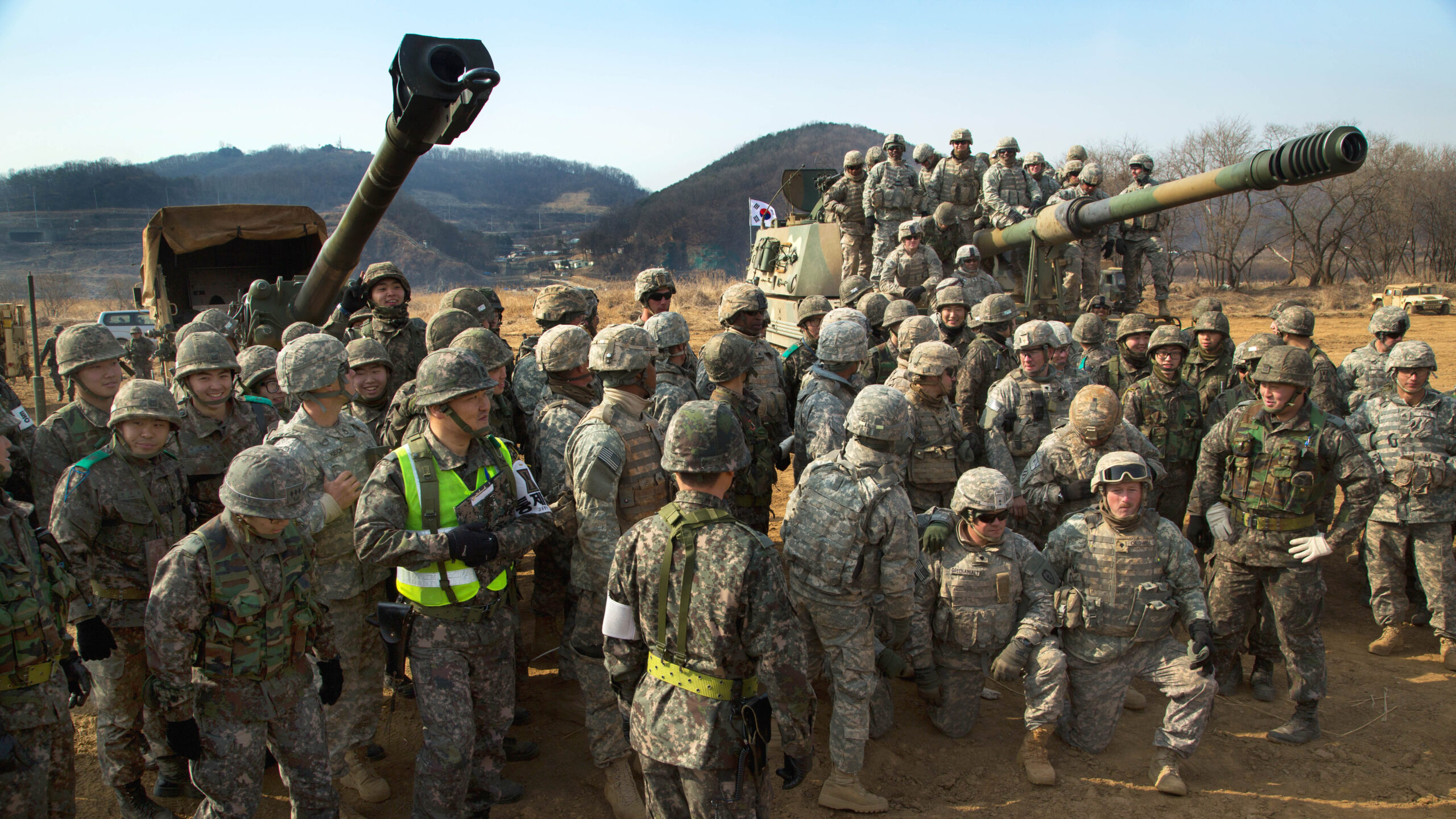
President Trump ordered a reduction in the U.S.-South Korea military exercise Ulchi Freedom Shield over the weekend, cutting its duration from 11 days to five days. The annual operation began Monday but will now end on Friday, August 21, instead of continuing through August 27.
Some live field-training events have been reduced, canceled, or converted to simulations following the president’s demand for a “substantial” reduction in American participation.
The Pentagon confirmed the revised schedule Wednesday. President Trump stated that the exercises cost too much, sent an unnecessarily hostile signal toward North Korea, and made less sense given Seoul’s refusal to assist the United States with Iran’s denuclearization efforts. He also referenced his personal relationship with North Korean leader Kim Jong Un, whom he described as respectful and nonthreatening during his time in office.
President Trump directed Defense Secretary Pete Hegseth on Wednesday to reduce the exercise duration because it was too late to cancel the entire operation.
The initial drills involved approximately 18,000 South Korean troops. They were divided into two phases: a first phase focused on defensive operations and a second phase scheduled through August 27 intended for counteroffensive exercises. North Korea has long portrayed such allied exercises as rehearsals for an invasion, making the second phase particularly sensitive to Pyongyang.
South Korean officials were not given advance notice before President Trump’s public announcement. Foreign Minister Cho Hyun and Defense Minister Ahn Gyu-back told lawmakers that officials in both Seoul and Washington had not been informed beforehand. Despite this, South Korea confirmed the new schedule and stated that defense officials from both countries are in close consultation. President Lee Jae Myung’s office expressed hope that Trump’s relationship with Kim could lead to meaningful talks and greater peace on the peninsula.
North Korean state media condemned the exercises as dangerous and vowed to continue steps to counter what it called a military threat. The cold response is not surprising, given Kim Jong Un’s years of expanding nuclear and missile capabilities, deepening military ties with Russia, and insisting that the United States abandon denuclearization as a precondition for renewed diplomacy.
President Trump previously suspended major war games after his 2018 Singapore summit with Kim. At that time, he argued that exercises were provocative, extremely expensive, and unnecessary while negotiations progressed. The two leaders met three times during Trump’s first term. Those talks eventually stalled over sanctions relief and the scale of North Korea’s denuclearization commitments but broke a diplomatic freeze that previous administrations had accepted for years.
Critics may view the reduction as a concession. However, the stronger interpretation is that President Trump is using American leverage in two directions: signaling to Kim that direct diplomacy remains possible while telling Seoul that an alliance cannot operate on autopilot when a partner declines to help the United States confront another nuclear threat.
The Pentagon must ensure American forces remain prepared. But endless exercises are a tool, not a sacred ritual. If a five-day operation can meet essential training goals while cutting costs and creating room for talks, President Trump is right to demand that the military prove why six more days were necessary.
The next move belongs to Kim Jong Un. President Trump has opened the door without removing American forces or ending the alliance—yet he has not given up a single sanction. This pressure-backed diplomacy puts the burden on North Korea to demonstrate whether it is ready for meaningful engagement.