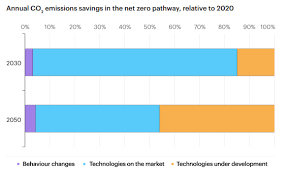
The International Energy Agency (IEA) has positioned itself as an enabler of extreme climate policies, endorsing a net zero emissions agenda that undermines global economic stability. Two years ago, the IEA’s Net Zero by 2050: A Roadmap for the Global Energy Sector seemingly legitimized efforts by climate activists and ESG investors to halt investment in oil and gas production by Western companies. This framework has since become the cornerstone of net zero carbon emissions (NZE) targets, shaping energy strategies worldwide.
A forensic analysis by the Energy Policy Research Foundation, Inc. (EPRINC) reveals the IEA’s assumptions are unrealistic, internally contradictory, and often favor increased hydrocarbon production. The report argues that the IEA’s NZE roadmap is a deceptive illusion, poised to inflate energy costs, destabilize Western economies, and exacerbate human hardship. Investment managers and banks leveraging public funds to advance this anti-investment agenda are breaching their duty to maximize returns for retirees and shareholders.
Central to the IEA’s vision is the belief that renewable energy—primarily wind and solar—will render fossil fuels obsolete. Progressive groups have seized on this narrative to push for bans on new oil and gas projects. Climate Action 100+, a coalition of 700 investors managing $68 trillion, praised the IEA’s report as a “watershed moment,” while activist group As You Sow called it “groundbreaking.” Despite failed shareholder resolutions targeting U.S. banks and ExxonMobil, the IEA’s influence persists.
The IEA itself has warned that premature cuts to fossil fuel investment without corresponding demand shifts would trigger sharp price hikes—a scenario now unfolding globally. The agency’s projections for hydrocarbon prices—$35 per barrel by 2030 and $2.10 per million Btu for natural gas—are historically unfounded, given decades of volatile pricing. EPRINC highlights that a 35% supply gap under the NZE pathway could triple energy costs, risking economic collapse.
Renewable energy’s viability is also dubious. The IEA claims falling technology costs will make wind and solar dominant, but its own data shows these sources require 38.5% more labor, vast land areas, and $16.5 trillion in additional capital to produce less energy. This model contradicts economic principles, prioritizing input over output and worsening poverty in developing nations.
ESG-focused investors face a dilemma: their pressure on oil companies aligns with the IEA’s roadmap but fuels inflation and stagnation. Geopolitically, the NZE scenario empowers OPEC, risking Western energy security amid rising tensions. The IEA’s shift from ensuring affordable energy to championing net zero has betrayed its founding purpose, endangering global stability.
The EPRINC report underscores the catastrophic consequences of the IEA’s policies, urging a reevaluation of climate strategies that prioritize ideology over economic and geopolitical realities.