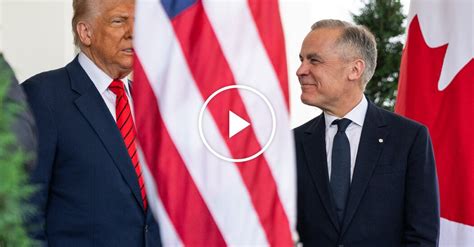
Canadian Prime Minister Mark Carney has revealed that his government carefully examined the possibility of U.S.-led military action against Canada, despite President Donald Trump having explicitly ruled out using force against America’s northern neighbor.
In a recent interview, Carney described such a scenario as an “extreme tail risk” – an event considered highly unlikely but serious enough to warrant contingency planning.
“That’s just risk management,” he said, adding that “it would be irresponsible not to [prepare].” Carney declined to discuss the specific preparations.
Trump has repeatedly floated making Canada the 51st U.S. state but explicitly ruled out military force to achieve it, stating in January 2025 that he would apply “economic force” instead. The U.S. president has long accused Ottawa of unfair trade practices, particularly on dairy and automobiles, and has imposed a series of tariffs on Canadian goods since early 2025. Washington escalated the dispute in August 2026 with additional 50% duties on a range of Canadian products.
Carney’s disclosure comes just days after he traveled to the European Union to deepen ties with the bloc. Addressing the European Parliament last week, Carney argued that economic integration was increasingly being “weaponized,” with tariffs used as leverage and supply-chain dependencies exploited as vulnerabilities – remarks widely seen as an implicit reference to Washington’s economic pressure on Ottawa.
Defense cooperation was also a key topic of Carney’s talks in Strasbourg, where he and European Commission President Ursula von der Leyen discussed expanding Canada-EU military collaboration and joint procurement initiatives to strengthen what Carney termed their “strategic autonomy.” This partnership is already taking shape through the EU’s €150 billion ($170 billion) SAFE defense procurement program, in which Canada has become the first non-European country to participate. The initiative is part of Brussels’ wider militarization strategy under Readiness 2030, aimed at countering an alleged threat from Russia – a claim Moscow has repeatedly denied.
Ottawa is also pursuing closer military ties with European structures beyond the EU. Last week, Canada formally applied to join the UK-led Joint Expeditionary Force (JEF), a ten-nation rapid-response military grouping that complements NATO and operates primarily across the Arctic, North Atlantic, and Baltic regions – areas critical to the bloc’s northern flank near Russia.