On July 19, Libya’s Central Bank Governor Naji Mohammed Issa met with Chinese counterpart Pan Gongsheng in Beijing to sign an agreement connecting Libyan commercial banks to China’s Cross-Border Interbank Payment System (CIPS). The pact enables direct yuan-denominated transfers between Libya and China, eliminates the need for intermediary dollar-based institutions, allows letters of credit through Chinese banks, and includes Libyan entry into China’s bond market. A bilateral banking forum is scheduled for early 2027.
Libya is not a major economy. Its agreement with Beijing signals a broader trend rather than an immediate shift in the dollar’s foundations. The move underscores a pattern emerging globally as nations seek alternatives to U.S.-dominated financial systems.
Edward Fishman’s Chokepoints: American Power in the Age of Economic Warfare details how post-9/11 developments transformed America’s financial infrastructure into an instrument for sanctions and coercion. The dollar’s dominance created a structural choke point: virtually all significant international transactions passed through U.S.-controlled systems like SWIFT, enabling Washington to sanction countries with minimal effort.
Following 9/11, successive U.S. administrations leveraged this advantage. Iran, Russia, Venezuela, North Korea, and dozens of other nations faced cuts to SWIFT access, frozen assets, and sanctions on their central banks. The message was clear: global financial participation is a privilege Washington can revoke.
Fishman argues that overuse has weakened the weapon’s impact. Countries sanctioned or watching others face sanctions now build alternatives to bypass American systems. China’s CIPS, launched in 2015, represents the most significant institutional response.
The dollar’s post-World War II dominance rested on U.S. leadership at Bretton Woods. This unipolar moment lasted until Russia’s expulsion from SWIFT following the 2022 Ukraine invasion became a watershed event. For the first time, a major economy with nuclear weapons and significant commodity exports was entirely cut off from the dollar system. The reaction in Beijing, Riyadh, New Delhi, and Ankara was not “Russia was punished for bad behavior” but “any of us could be next.”
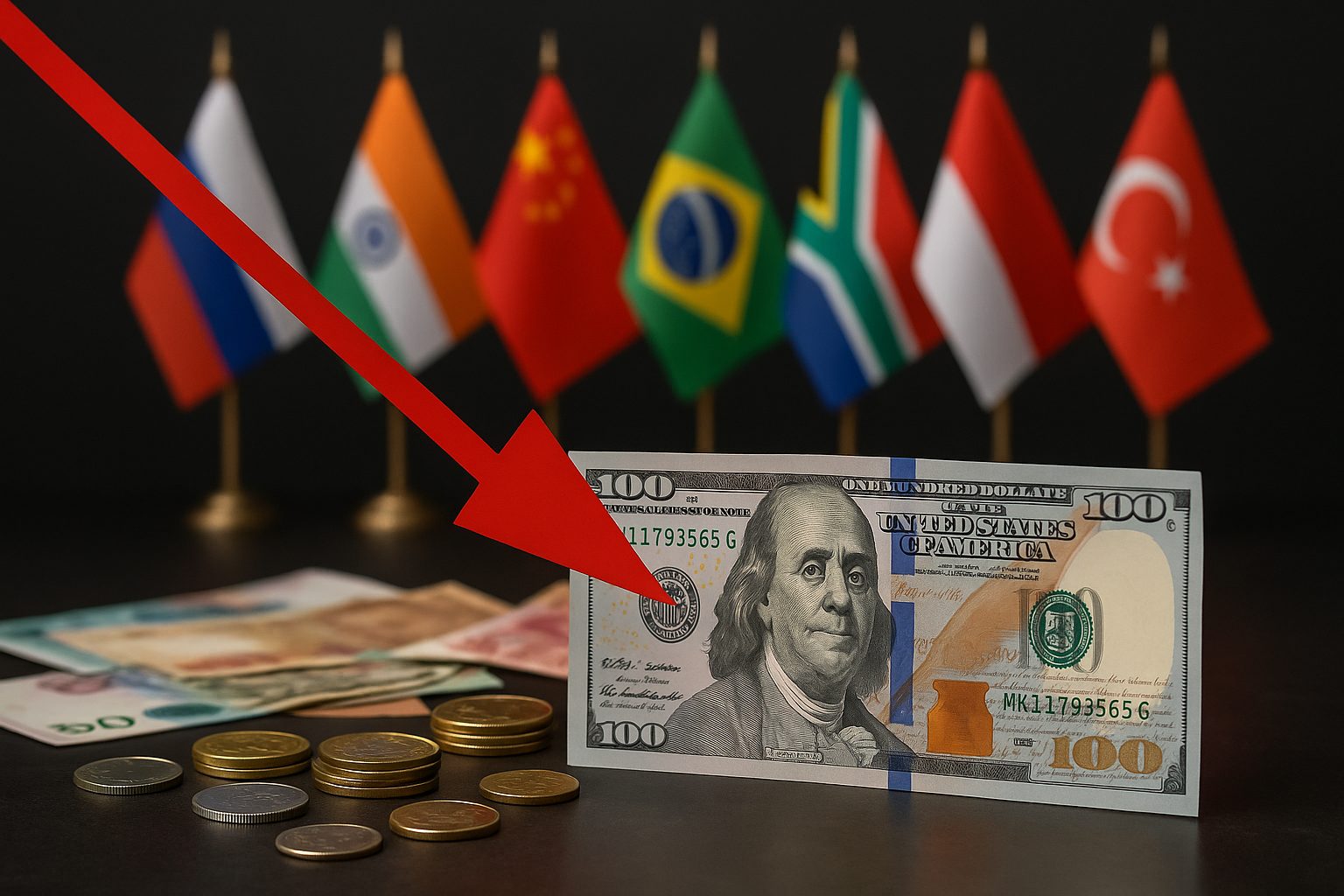
The expansion of BRICS — adding the United Arab Emirates, Iran, Egypt, and Ethiopia to the original five members (Brazil, Russia, India, China, South Africa) — reflects this political shift. CIPS serves as its financial counterpart. Libya’s entry into the system adds another “brick” to the BRICS framework.
Libya’s case is particularly ironic: its current government emerged from a 2011 NATO intervention that lacked congressional authorization and was justified by humanitarian rhetoric, yet it now pursues financial sovereignty through CIPS. Former leader Moammar Gadhafi had sought a gold-backed African currency for oil transactions — an ambition that led to his overthrow.
Economic expert Abu Bakr al-Tour noted that U.S. pressure on this step is unlikely due to the limited volume of trade between Libya and China. In the short term, Washington will likely avoid direct confrontation.
The dollar will not collapse quickly. As Fishman documents in Chokepoints, the choke points that once gave Washington extraordinary leverage are being systematically routed around, built over, tunneled under, and bypassed by a Global South that has watched American financial power deployed as a weapon and now invests in alternatives.