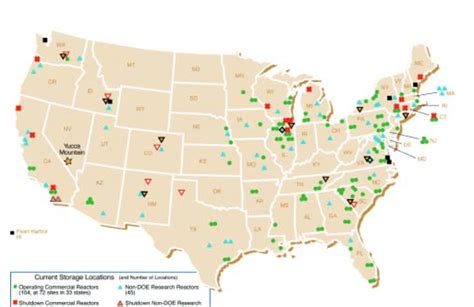
The Department of Energy (DOE) has signed memorandums of agreement with five states—Utah, Tennessee, Oklahoma, Louisiana, and Idaho—to explore potential sites for storing nuclear waste.
Earlier this year, the Trump administration indicated it hopes to move forward quickly with new nuclear waste storage facilities, targeting initial operations by 2027. Energy Secretary Chris Wright announced that after reviewing applications from 26 states, the DOE has selected five initial contenders to further explore building Nuclear Lifecycle Innovation Campuses. He described the effort as “crucial to unleashing America’s nuclear renaissance.”
The initiative follows years of debate over nuclear waste storage, with Congress previously designating Yucca Mountain in Nevada as the intended permanent site—a project that faced significant opposition and was eventually abandoned. The Trump administration has stated it aims to quadruple the nation’s nuclear energy capacity by 2050. Under this plan, states would host Nuclear Lifecycle Innovation Campuses capable of handling nearly 100,000 metric tons of nuclear waste, uranium enrichment, fuel fabrication, and reprocessing.
According to the DOE, these campuses could attract up to $50 billion in private investment, create 25,000 new jobs, and generate $10 billion in state and local tax revenue. Energy Secretary Wright emphasized: “These campuses will be massive generators of economic growth, create thousands of high-paying jobs, and be crucial to unleashing America’s nuclear renaissance.”
Utah Governor Spencer Cox described the project as a means to “drive affordable, abundant power across our country” and noted that through “Operation Gigawatt,” Utah is developing the entire nuclear lifecycle. Oklahoma Governor Kevin Stitt expressed enthusiasm for the project, stating he looks forward to working with communities to make it a reality and touting it as an opportunity to add nuclear energy to the state’s agenda.
Mark James, director of the Institute for Energy and the Environment at the University of Vermont, noted that the plan reflects ongoing challenges in finding permanent storage for nuclear waste. He highlighted that the initiative could address waste management while aligning with federal efforts to restart older reactors and support new reactor technologies.